

Hello, welcome to Humbly Courageous. I am glad you are here!
I met my friend Rainey in middle school. Throughout the years, we have been through a lot of ups and downs together. In high school, she didn’t miss a beat and helped me so much after my major surgery our senior year. We were also college roommates for a couple of years, and she has always been one of my most supportive friends. I love her dearly.
 In support of October being breast cancer awareness month, I want to share her story with you. One of her best qualities is that she is honest and tells it like it is. I knew when I asked her to share her story that her words would be authentic and powerful.
Tell me a little about when you were diagnosed. How long was your surgery and recovery period?
I was diagnosed during a college visit with one of my sons in September of 2022, on my late Grandmother’s birthday (she was a breast cancer survivor, too). I had a biopsy a few days before and I opened a MyChart message during some downtime on that visit. All I saw was “carcinoma,” and I knew I didn’t need to read anything else in that moment. I was called quickly after that by a Radiologist, referring me to a Breast Surgeon. After a couple months of countless doctors’ visits, procedures, and tests, I had a double mastectomy in early December, followed by a reconstruction surgery in March and another one a year later. I was lucky that my cancer was discovered at the earliest detection point possible and I didn’t need chemo or radiation, but recovering from a bilateral mastectomy was no walk in the park.

Her billboard moment!
What abilities did you lose during this time?
The recovery after the first surgery was the hardest. I had 4 drains that I couldn’t reach because my range of motion in my arms was very limited. I had nurse friends come to the house to help me with my drains until they were removed about 3 weeks after surgery. I couldn’t wash my hair. I couldn’t put any weight on my upper body using my arms, not even to scoot myself up in bed. I had a step stool by my bed so I could climb in without using my arms. I couldn’t reach anything above shoulder level. My kids joked that I suddenly had T-Rex arms. I had to go to physical therapy for several weeks to get that range of motion back. I was exhausted and even a trip to the doctor’s office wore me out, but I couldn’t sleep comfortably for months. My son also had a surgery just 2 weeks after mine and I hated that I couldn’t help him much in his recovery. Christmas was hard for the whole family that year.

Rainey with her supportive husband and kids
How did it feel to lose some of your independence, while also battling a serious illness, working, raising kids, and as a wife?
In short, it sucked. As a busy working mom who is actively involved in my kids’ activities, I wanted the impact of my cancer diagnosis on my family to be as small as possible. I remember telling my kids, “you are still going to your college interviews, and to your band and choir competitions, and everything else. Your life doesn’t stop for my cancer.” I am lucky to have the support of family and friends that helped me keep their lives as normal as possible during that time.
How did you cope with all the feelings that came with your diagnosis and the long road that followed?
I never felt so physically and emotionally fragile before in my life from diagnosis through the second surgery. It was a period of profound grief and I tried to keep that private, but my family saw through it. My husband deserves a medal for his patience and selflessness as I weighed treatment options and we planned for the inevitable that would derail our lives for a long while.
Did you feel like people started to look at or treat you differently after your diagnosis?
Absolutely. I didn’t want people to look at me and see and think “cancer.” They mean well, and some were trying to relate, but they didn’t always say or do helpful things. A mastectomy can’t be compared to a boob job. I didn’t choose cancer. I didn’t gain anything, I lost. They’re right when they say, “you’re lucky it’s not worse,” but it still sucks.
What was it like to go in a wheelchair to school functions for your kids?
Humbling. Lonely. I was so tired after my surgeries, but I was determined to make it to see my kids perform so I borrowed a wheelchair. I thought about you a lot on those days. It was like a day in the life of Amy. I remember my son pushing me through crowded high school hallways and stopping to talk to people who seemed unaware of my presence. I wasn’t always included in the conversations above me except for a brief ‘Hey, good to see you out and about! Feeling ok?’ Sometimes those talking around me would turn the conversation away from me and I was left in the wheelchair facing a wall. Other times, I would stand up to stretch and join the conversation and others would notice and joke ‘hey, you don’t need that wheelchair!’ or tell me I should sit back down and rest.
Has your perspective shifted or changed in the way you view disabilities or chronic illness since your diagnosis and fight against breast cancer?
Yes, thanks to you. I was minimizing my experience by saying things like “it could be a lot worse, I am lucky I don’t need chemo.” That’s true, and I have a cousin who was diagnosed with more advanced breast cancer than mine on the day of my mastectomy. She had a much harder and longer fight than me. I told myself I was never going to feel sorry for myself again because I had it easy compared to her. I remember telling you that and you stopped me right away and said, ‘you are allowed to feel bad about what is happening to you, Rainey. It could be worse, but it could be a lot better, too.’ Thank you for that important lesson, friend. You have no idea how much that helped me come to terms with my diagnosis and the loss I felt.
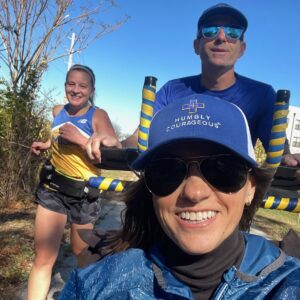
Rainey has run with Humbly Courageous and this was shortly after her diagnosis. Impressive!
How has connecting to others who went through or are going through what you did been meaningful to you?
One of my first thoughts after my diagnosis was What does this mean for my daughter, my sister, and all the women in my family? I felt I had to tell them right away. I felt called to share my story to encourage other women to get their mammograms. Remember, I skipped mine 2 years in a row before my diagnosis. I am a nurse. I know better. If I can get too busy for a mammogram, anyone can.
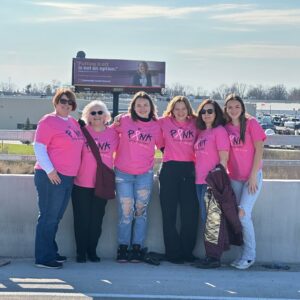
Rainey’s wonderful family
Did connecting with others who knew exactly what you were feeling help you during that time, and even now?
Honestly, yes and no. I talked to a lot of cancer survivors to gain insight into what was happening to me and I am forever grateful for the compassion they showed me, but sometimes it was too much for me to bear. The worst-case scenarios and the “you’ll never be the same again” stories haunted me. 4 years later, when a newly diagnosed friend or colleague wants to hear about my experience and ask my advice, I try to only answer the questions they have and not overshare. We all process this mess differently and we all have different ways to cope with it.

Do you think your diagnosis changed the way your kids see you now? Did it change them?
I am not sure. They still don’t like to talk about it too much. I remember my oldest son seeing me at a particularly vulnerable moment and it scared him. He is protective of me now, and seeing me at a moment of great weakness might have been the catalyst for his watchfulness.
Now that you have regained some abilities lost during that time, do you appreciate things that you did not used to even think twice about?
Definitely. Life is a gift, no matter how hard it can be at times.
What would you most like people to know if they or a loved one gets a breast cancer diagnosis?
Saying things like “just let me know how I can help, anything you need at all” isn’t helpful when you don’t know what you need. My advice is that if you think it will help them, just do it. Drop off a meal, send flowers, take the kids out to a movie. All gestures of kindness will be appreciated.
You and I have known each other for a long time. During the time we have known each other, how has your view of me changed throughout the years, and especially since going through your breast cancer battle?
Oh Amy, I have always had so much respect for you and the beautiful life you have made for yourself. When we were kids, I had no idea how challenged you were because of your disability. You hid it so well. Of course, I remember visiting you in the hospital and helping you move into your dorm and some minor accommodations that were made for you, AND I enjoyed the benefit of traveling in your car with a handicap sign 😉, but your life from my view seemed pretty “normal.” As adults, you have taught me so much about the parts of people’s lives we don’t see and how challenges can become opportunities. You are a realist and an optimist at the same time when you write and talk about your disability, and that is exactly what I needed to inspire me to get through my battle with cancer and to encourage me to try and help others through theirs.
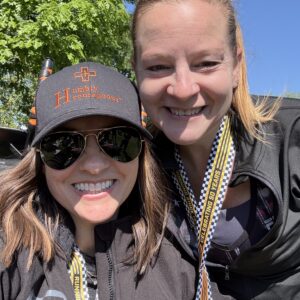
Thank you so much Rainey for the vulnerabilities you share, and the light you are in the world!